
The acronym Dr. Vito Lavanga, orthopaedic spine surgeon at Ortho-Next in Lainate, explains in a short video with 3D rendering what TLIF (Transforaminal Lumbar Interbody Fusion) is. It is one of the most widely used operations to treat stenosis, spondylolisthesis and instability of the lumbar spine when conservative treatment is no longer enough.
What TLIF is
The lumbar spine is made up of vertebrae separated by intervertebral discs. Between one vertebra and the next, on each side, are the intervertebral foramina: small “channels” through which the nerve roots leading to the legs exit. When the disc wears out, when one vertebra slips over another (spondylolisthesis) or when ligaments and joints thicken, these spaces narrow and the nerve root is compressed. The result is back and leg pain, tingling, weakness and difficulty walking.
TLIF reaches the disc from behind and from the side, passing right through the foramen. Through a single posterior approach it achieves three things: decompressing the nerves, restoring disc height and performing spinal fusion (arthrodesis) of the vertebral segment [1], [2].
1. Laminectomy: freeing the nerve root
The first stage of the operation is decompression. With laminectomy the lamina is removed, i.e. the back part of the vertebra that forms the “roof” of the spinal canal. On the side of the approach, the facet joint is also removed (facetectomy/foraminotomy). This removes the bone and tissue pressing on the nerve, and the irritated nerve root is freed and has room again [1], [2].
The transforaminal route allows the disc to be reached with very little movement of the dural sac and nerve roots. This is one of the reasons why the technique has become more widespread than more traditional posterior approaches [2].
2. The titanium cage: keeping the space open
Freeing the nerve is not enough: if the disc remains collapsed, the foramen would tend to close again. This is why the degenerated disc is removed and a titanium interbody cage, filled with bone graft, is inserted into the space between the two vertebrae. The cage restores disc height, keeps open the foramen through which the nerve root exits, and acts as a “bridge” on which the two vertebrae fuse over the following months [1].
3. Pedicle screws and rods: spinal fusion (arthrodesis)
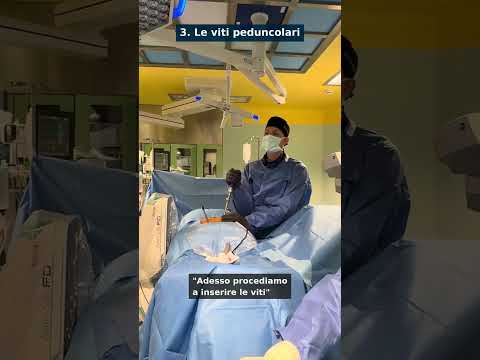
To protect the cage and allow the bone to fuse, the segment must be immobilised. This is done with pedicle screws, which are inserted from back to front, through the pedicle: the “bridge” of strong bone connecting the back of the vertebra to the vertebral body. In this way the screw passes through the pedicle and anchors firmly in the body of the vertebra.
The screws in neighbouring vertebrae are then connected with two posterior rods, one on each side. Together they form a solid frame that holds the vertebrae still while they fuse, with the cage in the middle and the screws and rods behind [1], [2].
TLIF or PLIF? What the studies say
PLIF (posterior lumbar interbody fusion) is the “sister” technique of TLIF. A systematic review with meta-analysis of patients with lumbar spondylolisthesis found comparable clinical results between the two techniques, but with TLIF there were fewer complications: in particular fewer dural injuries and less nerve damage, as well as shorter operating times and less blood loss [3].
When a TLIF is considered
- Degenerative or isthmic spondylolisthesis with pain and leg symptoms;
- stenosis of the canal or foramina associated with segmental instability;
- recurrent disc herniations or selected degenerative disc disease;
- symptoms that persist despite physiotherapy, medication and injections.
Not all back pain requires surgery. In most cases, treatment starts with exercise, physiotherapy and conservative therapy. Surgery is proposed only after a thorough consultation and an MRI and dynamic X-rays, when the expected benefits clearly outweigh the risks.
After surgery
Patients are usually out of bed within the first few days. This is followed by a gradual rehabilitation programme and X-ray checks that confirm, over time, that the vertebrae have fused. Timing and recommendations are always personalised.
Spine surgery consultation in Lainate with Ortho-Next
If you suffer from low back pain radiating down the leg, tingling or difficulty walking, Dr. Vito Lavanga can assess your case at Ortho-Next in Lainate and at the other centres where he operates. Together you will choose the most suitable pathway, conservative or surgical.
Information only: this does not replace a medical consultation.
Scientific references (PubMed)
- Mobbs RJ, Phan K, Malham G, Seex K, Rao PJ. Lumbar interbody fusion: techniques, indications and comparison of interbody fusion options including PLIF, TLIF, MI-TLIF, OLIF/ATP, LLIF and ALIF. J Spine Surg. 2015;1(1):2-18. PMID: 27683674
- Cole CD, McCall TD, Schmidt MH, Dailey AT. Comparison of low back fusion techniques: transforaminal lumbar interbody fusion (TLIF) or posterior lumbar interbody fusion (PLIF) approaches. Curr Rev Musculoskelet Med. 2009;2(2):118-126. PMID: 19468868
- de Kunder SL, van Kuijk SMJ, Rijkers K, et al. Transforaminal lumbar interbody fusion (TLIF) versus posterior lumbar interbody fusion (PLIF) in lumbar spondylolisthesis: a systematic review and meta-analysis. Spine J. 2017;17(11):1712-1721. PMID: 28647584