
Conditions · Spine surgery · Lainate
Scoliosis in adolescents and adults: symptoms and treatment
Scoliosis is an abnormal sideways curvature of the spine. It is more accurate to speak of rotoscoliosis, because the curve is accompanied by rotation of the vertebrae.
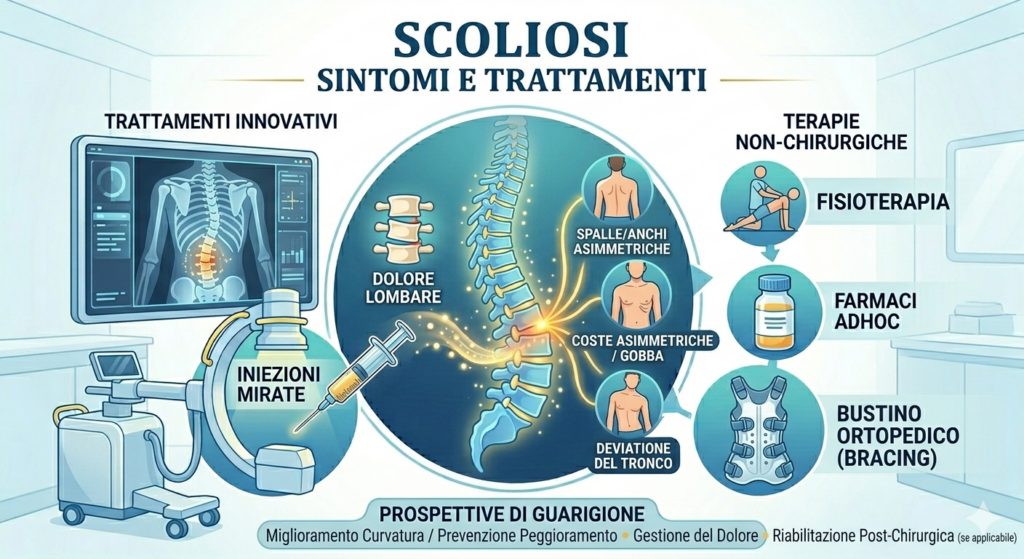
Types of scoliosis
- "C" curve: a single main curve.
- "S" curve: two main opposite curves.
The deformities may be more or less visible and are often accompanied by a rib or lumbar hump . A distinction is made between adolescent idiopathic scoliosis, which appears during growth, and adult scoliosis, which is often degenerative.
Signs to look out for
- Body asymmetry: one shoulder higher than the other, a more prominent hip, an asymmetric chest.
- A hump that appears when bending forward.
- Back pain, especially in adults, and muscle fatigue.
- In adults, pain and tingling in the legs when the curve narrows the canal or the foramina.
- In severe cases, breathing difficulties.
How it is assessed
The examination includes the forward bend test and measurement of asymmetries. A full-length standing X-ray of the spine makes it possible to measure the Cobb angle and, in adolescents, skeletal maturity, on which the risk of progression depends. In adults, sagittal balance is also assessed, and the nerves are studied with MRI.
How it is treated
- Observation: for mild curves, regular check-ups are enough.
- Orthopaedic brace: in growing adolescents, to prevent progression; the type of brace and the hours of wear depend on each case.
- Physiotherapy: specific exercises for posture, strength and flexibility.
- Surgery: for severe or rapidly progressing curves, with correction by spinal fusion.
Does bracing really work?
Yes, in adolescents with curves at risk. In the BrAIST study, bracing significantly reduced curve progression to the surgical threshold: success in 72% of adolescents treated with a brace versus 48% of those only observed, with a greater benefit the more hours per day it was worn [1]. The SOSORT guidelines describe the role of bracing and specific exercises during growth [2].
Surgery for adult scoliosis
In adults, surgery is mainly proposed for leg pain, loss of sagittal balance or a worsening curve. It combines decompression of the nerves, interbody cages (including via a minimally invasive lateral approach) and spinal fusion (arthrodesis) with screws and rods, using percutaneous techniques whenever possible. The plan is always personalised according to the patient's age, bone quality and expectations.
Videos by Dr. Lavanga
Adult scoliosis
Adult scoliosis: leg symptoms and percutaneous surgery
Videos load from YouTube (youtube-nocookie.com) only when you press ▶.
Related articles
Scientific references (PubMed)
- Weinstein SL et al. Effects of bracing in adolescents with idiopathic scoliosis. N Engl J Med. 2013. PMID 24047455
- Negrini S et al. 2016 SOSORT guidelines: orthopaedic and rehabilitation treatment of idiopathic scoliosis during growth. Scoliosis Spinal Disord. 2018. PMID 29435499
Information only: this does not replace a medical consultation, diagnosis or personalised treatment.