
Conditions · Spine surgery · Lainate
Lumbar stenosis: symptoms, diagnosis and treatment
Lumbar stenosis is a narrowing of the spinal canal in the lower back: the word "stenosis" actually means "narrowing". The space for the nerves is reduced, causing pain, tingling and difficulty walking.
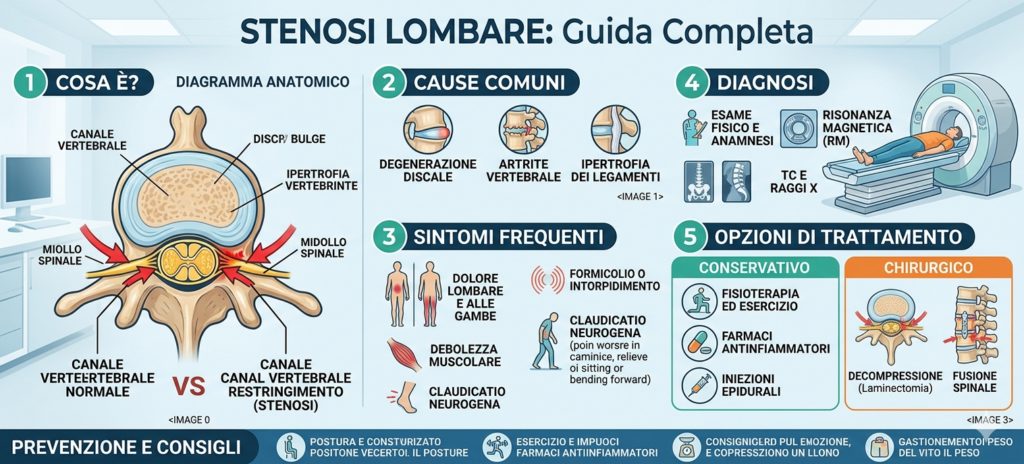
Anatomy and causes
- Hypertrophy of the ligamentum flavum: the ligament lining the back of the canal thickens and compresses the dural sac.
- Facet joint arthritis: degeneration of the joints forms bone spurs (osteophytes) that narrow the canal.
- Disc herniation or protrusion, which further reduces the available space.
- Congenital conditions: some people are born with a narrower canal.
- It is often associated with spondylolisthesis of the degenerative type.
Main symptoms
- Neurogenic claudication: pain, heaviness and weakness in the legs that come on when walking and ease when stopping or sitting down, often by bending forward.
- Low back pain that may radiate to the buttocks and legs.
- Sciatica, numbness and tingling in the legs and feet.
- Muscle weakness and balance problems.
Diagnosis
- Magnetic resonance imaging (MRI): shows the canal, the nerves and the degree of compression.
- Computed tomography (CT): useful for bony structures.
- Standing and dynamic X-rays: assess alignment and abnormal movement of the vertebrae.
- Electromyography (EMG): in selected cases, to assess nerve damage.
Conservative treatment
Treatment depends on the severity of symptoms. Options include medication, physiotherapy with exercises for strength and flexibility, physical and manual therapies and, in selected cases, injections. Staying active is important: cycling and walking with poles (Nordic walking) are often well tolerated because they are done with the upper body leaning slightly forward.
What the studies say: surgery or conservative treatment?
In the SPORT study, patients with lumbar stenosis who had surgery showed, on average, greater improvement in pain and function at two years than those who continued non-surgical treatment [1]. A Cochrane review, on the other hand, concludes that the comparative evidence is of low quality and recommends informing patients carefully about the benefits and side effects of each option [2]. The NASS guidelines guide the choice according to symptoms, duration and response to treatment [3]. This is why surgery is proposed when symptoms genuinely limit daily life and well-conducted treatment is not enough.
Surgery: direct and indirect decompression
The aim of surgery is to give the nerves room again. In direct decompression (laminectomy, laminotomy, including the biportal endoscopictechnique), part of the bone and the thickened ligamentum flavum are removed. In indirect decompression disc height is restored with an interbody cage inserted, for example, via a lateral or anterior approach: the canal and foramina reopen without directly touching the structures compressing the nerves.
Is spinal fusion always needed?
No. In a Swedish randomised trial of patients with lumbar stenosis, with or without degenerative spondylolisthesis, adding spinal fusion to decompression did not improve outcomes at 2 and 5 years, with longer hospital stays and higher costs [4]. Therefore,spinal fusion (arthrodesis) is reserved for cases with abnormal segmental motion, deformity, or when the decompression required would compromise the balance of the spine.
Prevention and management
- A healthy body weight, to reduce the load on the spine.
- Regular exercise that strengthens the back muscles and maintains flexibility.
- Correct posture in everyday activities.
With early diagnosis and appropriate treatment, many patients manage their symptoms and continue to lead an active life.
Videos by Dr. Lavanga
Lumbar stenosis among spinal conditions
The history of spinal stenosis symptoms
Stenosis and neurogenic claudication (Top Doctors)
Direct and indirect decompression of the spinal canal
Indirect decompression on LA7 – Le parole della salute
What lumbar stenosis is and how lumbar spinal fusion works
Videos load from YouTube (youtube-nocookie.com) only when you press ▶.
Related articles
Scientific references (PubMed)
- Weinstein JN et al. Surgical versus nonsurgical therapy for lumbar spinal stenosis. N Engl J Med. 2008. PMID 18287602
- Zaina F et al. Surgical versus non-surgical treatment for lumbar spinal stenosis. Cochrane Database Syst Rev. 2016. PMID 26824399
- Kreiner DS et al. An evidence-based clinical guideline for the diagnosis and treatment of degenerative lumbar spinal stenosis (update). Spine J. 2013. PMID 23830297
- Försth P et al. A Randomized, Controlled Trial of Fusion Surgery for Lumbar Spinal Stenosis. N Engl J Med. 2016. PMID 27074066
Information only: this does not replace a medical consultation, diagnosis or personalised treatment.