
Conditions · Spine surgery · Lainate
Cervicobrachialgia and cervical disc herniation: from the neck to the arm
The cervical spine is the most mobile segment of the spine and the one bearing the least load, yet it is the second most commonly affected by disease after the lumbar spine. Cervicobrachialgia is pain that radiates from the neck into the arm.
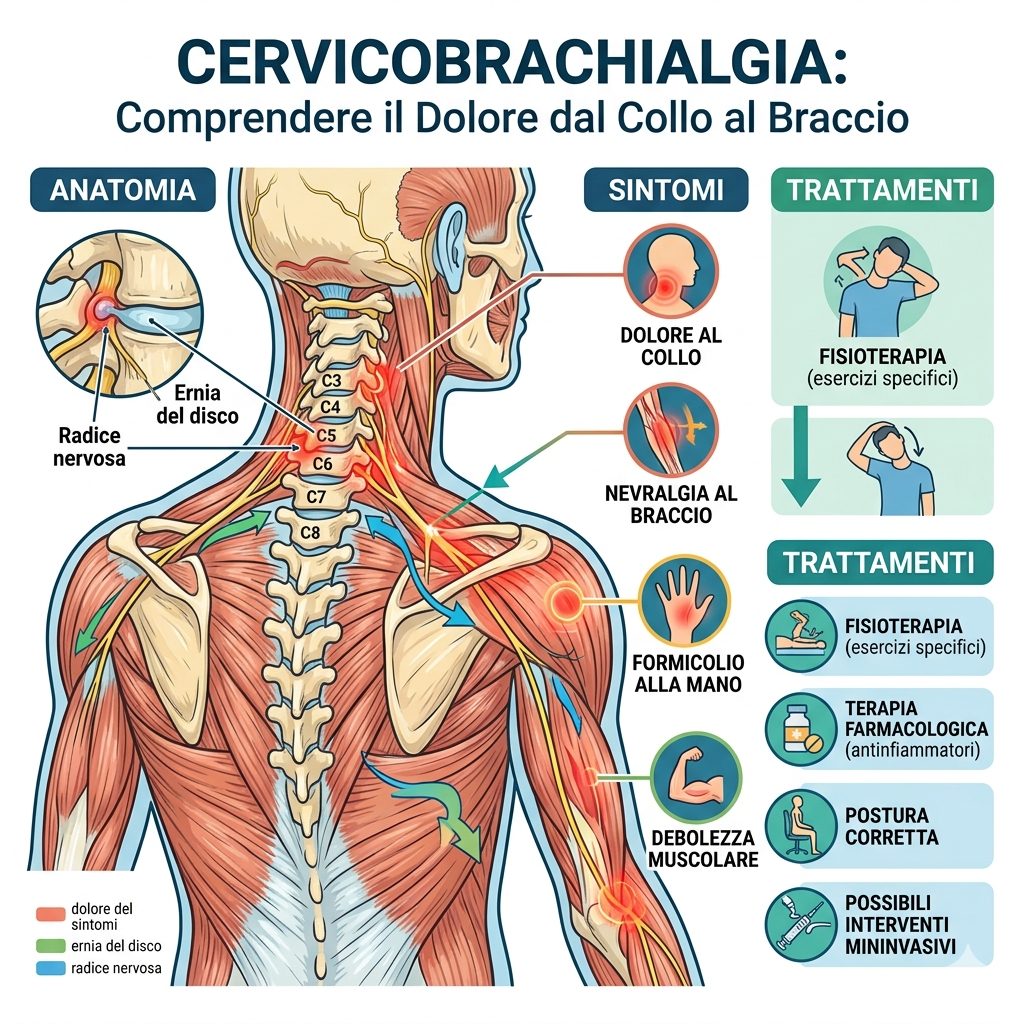
Anatomy of the cervical spine
The neck is made up of seven vertebrae, each with a different shape: theatlas (C1) supports the weight of the head; theaxis (C2) acts as a pivot and allows the "no" and "yes" movements. Fun fact: all mammals have seven cervical vertebrae.
The main conditions of the neck
- Cervical disc herniation: compresses a nerve root and causes cervicobrachialgia.
- Cervical spondylosis: arthritis with long-standing symptoms, mainly neck pain, more common in older age and often affecting several levels.
- Cervical myelopathy: damage to the spinal cord, with brisk reflexes, gait disturbance, increased muscle tone and pathological reflexes (Babinski, Hoffmann).
Symptoms
- Neck pain that may extend from the base of the skull to the shoulder.
- Arm pain reaching down to the hand, often sharp or burning.
- Tingling and numbness in the arm and fingers.
- Weakness of the arm and hand muscles.
When to be concerned
These should be assessed promptly: clumsy hands (difficulty buttoning clothes, writing, holding objects), unsteadiness when walking, tingling in both hands or in the legs, worsening loss of strength. These may be signs of myelopathy: international guidelines recommend surgery for moderate and severe forms, and close monitoring or surgery for mild forms [2].
How it is treated
- Medication: painkillers, NSAIDs and muscle relaxants.
- Physiotherapy: exercises to strengthen the neck muscles and improve posture.
- Physical and manual treatments, such as cervical traction.
- Injections in selected cases.
The natural history is often favourable
In cervical radiculopathy due to disc herniation, most patients improve with conservative treatment within weeks or a few months; surgery is reserved for persistent and disabling pain, significant motor deficits or signs of spinal cord compression [1].
Surgery
When necessary, surgery removes the herniation and decompresses the nerves. The most widely used technique isanterior cervical discectomy and fusion (ACDF), performed under the microscope. In myelopathy, surgical decompression improved function and quality of life in a large multicentre study [3].
Prevention
- Correct posture and an ergonomic workstation, with the screen at eye level.
- Regular exercise for the neck and shoulder muscles.
- Avoiding sudden movements and excessive strain.
Videos by Dr. Lavanga
Neck twinges and tingling fingers? It may not be a stiff neck
Neck problems on Detto Fatto (Rai 2)
Videos load from YouTube (youtube-nocookie.com) only when you press ▶.
Related articles
Scientific references (PubMed)
- Carette S et al. Clinical practice. Cervical radiculopathy. N Engl J Med. 2005. PMID 16049211
- Fehlings MG et al. A Clinical Practice Guideline for the Management of Patients With Degenerative Cervical Myelopathy: Recommendations for Patients With Mild, Moderate, and Severe Disease and Nonmyelopathic Patients With Evidence of Cord Compression. Global Spine J. 2017. PMID 29164035
- Fehlings MG et al. Efficacy and safety of surgical decompression in patients with cervical spondylotic myelopathy: results of the AOSpine North America prospective multi-center study. J Bone Joint Surg Am. 2013. PMID 24048552
Information only: this does not replace a medical consultation, diagnosis or personalised treatment.