
Conditions · Spine surgery · Lainate
Spondylolisthesis: when a vertebra slips
The word "spondylolisthesis" combines "spondylo" (vertebra) and "olisthesis" (slipping): one vertebra slips forward over the one below.
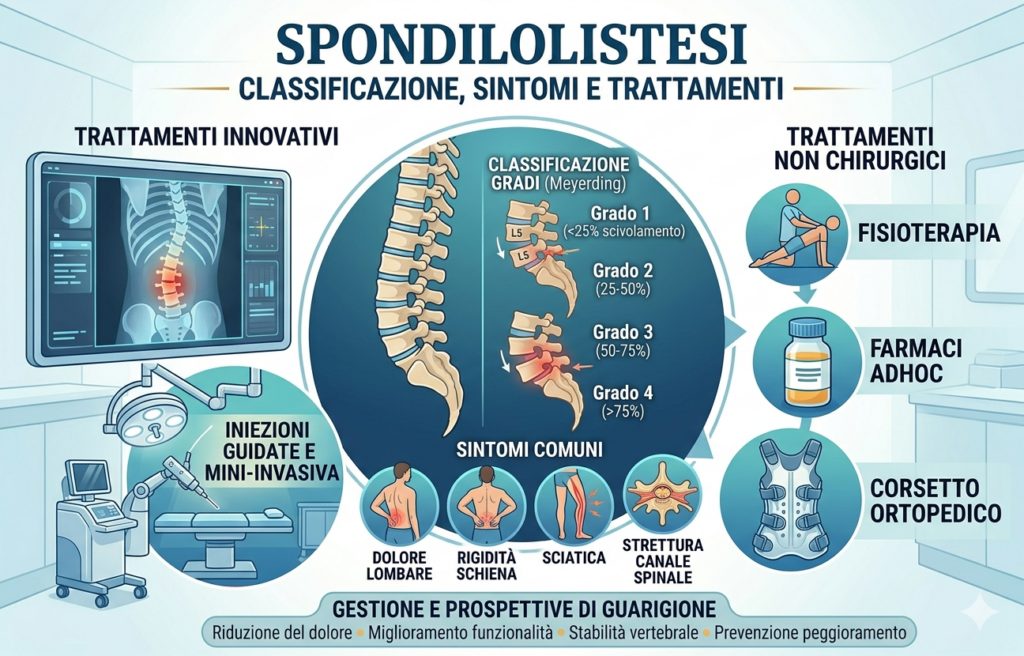
Classification
It is classified by the degree of slippage according to Meyerding:
- Grade 1: slippage up to 25%
- Grade 2: 25–50%
- Grade 3: 50–75%
- Grade 4: over 75%; complete slippage is called spondyloptosis
Causes
- Isthmic: due to a break in the vertebral isthmus (spondylolysis), often present since adolescence, most common at L5-S1.
- Degenerative: linked to ageing of the disc and facet joints, most common at L4-L5 and in women over 50.
- Congenital or traumatic.
- Pathological: due to diseases of the bone or connective tissue.
Main symptoms
Spondylolisthesis can be asymptomatic, especially in athletes. When it causes symptoms, the most common are:
- low back pain that may radiate to the buttocks and legs;
- stiffness and tension in the lower back muscles;
- sciatica, tingling and numbness;
- difficulty walking, as in lumbar stenosis, when the slippage narrows the canal.
How it is diagnosed
After the consultation, standing X-rays, including flexion and extension views, measure the degree of slippage and show whether the segment moves abnormally. MRI assesses the discs and nerves; CT is useful to see the break in the isthmus. The diagnosis and conservative management of the degenerative form are summarised in a dedicated review [1].
How it is treated without surgery
- Medical assessment to understand whether the condition is progressing and to plan the care pathway.
- Physiotherapy focused on the strength and flexibility of the trunk muscles.
- Postural correction in everyday activities.
- Medication for the symptoms.
Spondylolisthesis is not an "all or nothing" condition: with early diagnosis and appropriate management, you can keep leading an active life.
When spinal fusion (arthrodesis) is considered
Surgery is considered when leg pain, claudication or neurological deficits persist despite treatment, or when the slippage progresses. In the SPORT study, patients operated on for degenerative spondylolisthesis had better results at two years than those treated without surgery [2]. In grade 1 degenerative spondylolisthesis, adding spinal fusion to laminectomy gave a modest but clinically significant improvement in physical quality of life [3], while another randomised trial found no advantage of adding fusion in patients with stenosis, with or without spondylolisthesis [4]. The choice must therefore be personalised, assessing above all any abnormal motion of the segment.
The operation
When indicated,lumbar spinal fusion frees the compressed nerves, restores disc height with an interbody cage and immobilises the segment with pedicle screws and rods until the bone fuses. The techniques (TLIF, XLIF, ALIF) are chosen according to the level and the patient's anatomy.
Videos by Dr. Lavanga
The case of an isthmic spondylolisthesis operated on six months earlier
Spinal fusion and decompression: what is done in practice
Videos load from YouTube (youtube-nocookie.com) only when you press ▶.
Related articles
Scientific references (PubMed)
- Kalichman L et al. Diagnosis and conservative management of degenerative lumbar spondylolisthesis. Eur Spine J. 2008. PMID 18026865
- Weinstein JN et al. Surgical versus nonsurgical treatment for lumbar degenerative spondylolisthesis. N Engl J Med. 2007. PMID 17538085
- Ghogawala Z et al. Laminectomy plus Fusion versus Laminectomy Alone for Lumbar Spondylolisthesis. N Engl J Med. 2016. PMID 27074067
- Försth P et al. A Randomized, Controlled Trial of Fusion Surgery for Lumbar Spinal Stenosis. N Engl J Med. 2016. PMID 27074066
Information only: this does not replace a medical consultation, diagnosis or personalised treatment.